
Ensuring stringent hygiene standards has never been more crucial in healthcare settings, where hospital-acquired infections represent a persistent threat to patient safety. Traditional curtains, while essential for privacy, are often overlooked sources of contamination and can rapidly become reservoirs for pathogens. The need for a more innovative, more effective solution is clear—enter PRVC Systems, a national leader renowned for its cutting-edge cubicle curtains and modular track solutions engineered for the ever-evolving demands of medical environments. With a proven presence in key markets, including Texas and across the U.S., PRVC Systems delivers specialized products and expert consulting, helping hospitals elevate infection control while maintaining patient dignity and operational efficiency.
What sets PRVC Systems apart is the company’s commitment to combining innovation with practicality. Their wall-mounted track solutions and focus on antimicrobial fabrics embody years of research and experience, ensuring hospital staff can change curtains quickly, without risking injury or disrupting patient care. As hospital administrators and infection control teams seek new ways to break the chain of transmission, PRVC Systems emerges as a trusted authority, bringing together technology, expertise, and health-first design.
How Quickly Do Hospital Curtains Become Contaminated?
Hospital privacy curtains, often considered benign, can become heavily contaminated within days of installation. Studies have documented that these curtains can accumulate significant bacterial loads—including notorious pathogens such as methicillin-resistant Staphylococcus aureus (MRSA)—within a week. This rapid colonization is particularly problematic because curtains are touched frequently by healthcare workers and patients alike, creating a critical touchpoint for cross-contamination in busy wards and patient rooms.
Frequent, diligent curtain changes are essential for breaking this cycle. However, traditional curtain systems are often labor-intensive to maintain, demanding time and resources that many hospitals struggle to spare. The urgency of addressing curtain contamination is underscored by research from institutions such as the Association for Professionals in Infection Control and Epidemiology, which highlights how overlooked surfaces play a direct role in the spread of HAIs.
What Challenges Do Traditional Curtain Systems Present?
Conventional ceiling-mounted curtain tracks complicate hygienic maintenance and expose staff to preventable risks. Curtain change procedures typically require maintenance teams to use ladders or step stools, increasing the likelihood of workplace accidents—especially falls, which remain a leading cause of injury among healthcare workers. Extended curtain change times, often exceeding an hour per hospital room, further diminish staff efficiency, leading to unnecessary room downtime and possible care delays.
Additionally, ceiling tracks and bulky curtain hardware can obstruct other critical hospital equipment, including overhead patient lift systems. When curtain systems and patient lifts clash, caregivers face interruptions to patient transfers—a scenario that endangers both staff ergonomics and patient well-being. As hospitals strive for seamless workflows and safer patient handling, addressing these hardware conflicts is no longer optional; it is mandatory for modern healthcare facilities.

How Does PRVC Systems Address These Challenges?
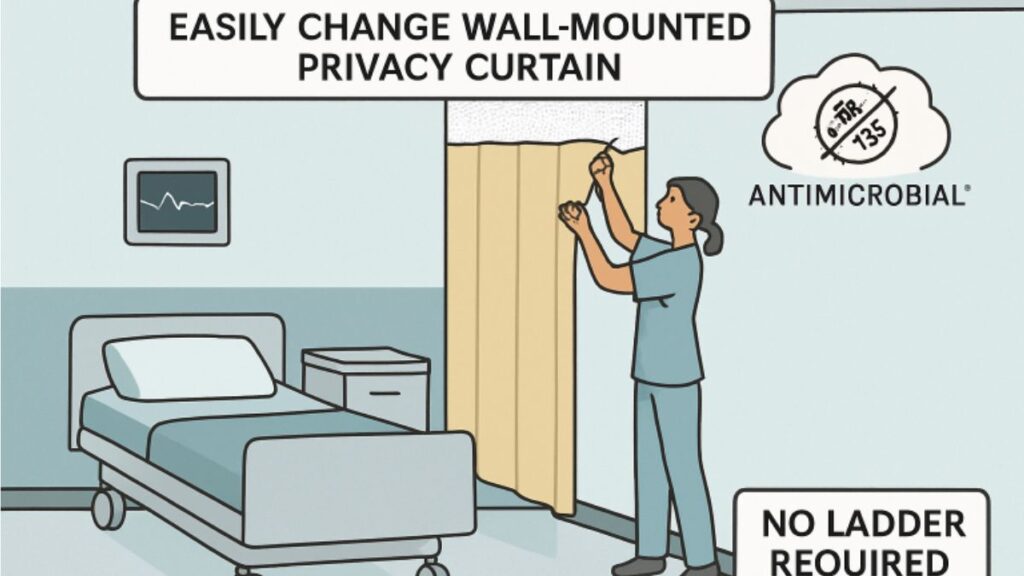
- Wall-Mounted Tracks: With a unique, patented wall-mounted track system, PRVC Systems eliminates the need for ladders, allowing staff to replace curtains from the safety of the floor in seconds. This innovation dramatically reduces the risk of falls and saves countless labor hours each year.
- Antimicrobial Fabrics: The brand’s proprietary curtain fabrics are engineered with advanced antimicrobial properties that actively resist bacterial and viral colonization. By incorporating these materials, hospitals can keep curtain surfaces cleaner for longer, thereby minimizing the potential for pathogen transmission between curtain change intervals.
- Lift System Integration: PRVC’s solutions are designed with healthcare realities in mind, ensuring total compatibility with all overhead and portable patient lift systems. This lets hospitals maintain both privacy and direct care access—an essential aspect of safe, dignified patient handling.
What Are the Benefits of PRVC Systems’ Curtain Solutions?
- Enhanced Infection Control: Between antimicrobial curtains and effortless changeability, PRVC’s products consistently reduce HAI risks, fortifying hospital infection prevention programs.
- Operational Efficiency: Swift, tool-free curtain changes reduce room downtime, lower maintenance costs, and free up more resources for patient-centered care.
- Improved Safety: By removing ladders and promoting ergonomic maintenance, PRVC Systems ensures changes are safer and easier for healthcare staff.
- Patient Dignity and Privacy: Unhindered access to lift systems ensures that patient transfers are private and safe, maintaining respect for patient dignity throughout their stay.
The Centers for Disease Control and Prevention (CDC) continues to underscore the importance of environmental controls in minimizing HAIs, making innovative approaches such as those offered by PRVC a high-value component of modern hospital management.
How Have Healthcare Facilities Benefited from PRVC Systems?
Across the United States, hospitals and clinics adopting PRVC curtain solutions are reporting measurable gains. At the Veterans Affairs Medical Center in Washington, D.C., more than 500 rooms now feature PRVC wall-mounted curtain tracks—yielding improved patient privacy, faster room turnovers, and safer working conditions for staff. Administrative leaders also note that easier curtain changes contribute to better compliance with infection prevention protocols, further decreasing transmission risk.
Hospitals in Texas, California, and elsewhere also tout PRVC’s attention to local compliance standards, including fire and life-safety requirements, ensuring facilities not only improve infection control and efficiency but also meet rigorous health and safety regulations. This results in fewer coverage gaps and greater peace of mind for both patients and healthcare providers.
Conclusion
The challenges posed by traditional hospital curtains—rapid contamination, inefficient maintenance, and interference with critical care equipment—are no longer insurmountable hurdles. With PRVC Systems’ expertise and advanced curtain solutions, healthcare facilities can adopt a proactive, comprehensive approach to infection prevention, workforce safety, and patient experience. Hospitals seeking to exceed modern hygiene and efficiency expectations should consider these innovations as essential investments for safer, more reliable care environments.