
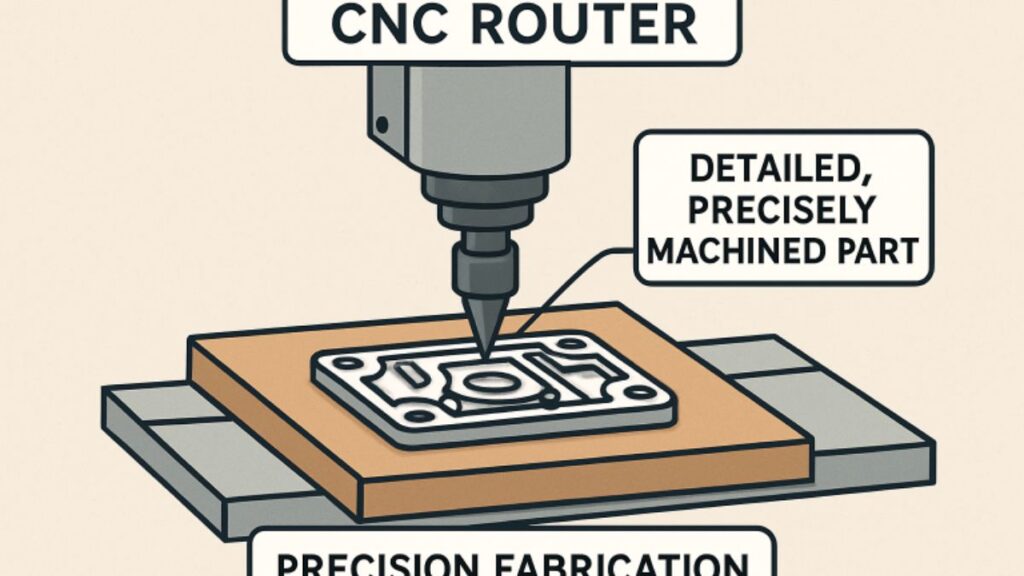
Computer Numerical Control (CNC) router machines are transforming precision fabrication across manufacturing industries. Their ability to deliver exceptional accuracy and productivity is positioning them as indispensable equipment for applications ranging from aerospace components to fine custom woodworking. As technology evolves, industry leaders like Phantom CNC Systems are pushing the boundaries of what is possible, harnessing digital innovations to meet modern manufacturing demands.
As CNC technology enters a new era, future advancements promise to push precision even further, reduce waste, and streamline operations. These improvements will allow manufacturers to tackle increasingly complex projects, support greater sustainability, and adopt new materials and processes with confidence. The possibilities on the horizon signal an exciting future for businesses looking to stay ahead in a competitive market.
AI Integration Enhancing Precision
AI is transforming CNC router precision by analyzing real-time data to optimize the machining process, from cutting strategies to feed rates. This adaptive AI improves accuracy, reduces errors, and ensures consistent quality during long runs. It predicts and prevents issues like tool wear and incorrect setups, minimizing downtime. AI also offers flexibility for changing designs and rapid prototyping, especially important in customizable industries. Forbes notes AI is advancing manufacturing with predictive maintenance and dynamic optimization, shaping the future.
Multi-Axis Capabilities for Complex Designs
Traditional CNC machines typically utilize three axes, but the development and adoption of 5-axis and even 9-axis configurations are enabling far more complex geometries. These advanced machines can rotate and move workpieces in multiple directions, reducing the need for several setups and the associated potential for errors. As a result, manufacturers can produce high-precision parts with intricate features more quickly and with greater reliability.
The implications are significant, particularly in fields such as aerospace and automotive. Complex contours and undercuts that were once difficult, or even impossible, to machine can now be fabricated more efficiently. Multi-axis CNC routers are also credited with improving the repeatability and speed of part production, further expanding the scope of what can be achieved with CNC technology.
Hybrid Manufacturing: Combining Additive and Subtractive Processes
The convergence of subtractive (CNC) and additive (3D printing) manufacturing represents the next evolutionary step for precision fabrication. By leveraging the strengths of both processes, manufacturers achieve tremendous flexibility in designing and producing parts. For example, additive manufacturing can build complex internal structures or near-net shapes, which are then refined to precise tolerances with CNC milling or turning.
This hybrid model not only allows for innovative geometries but also reduces production waste and expedites prototyping. Industries that rely on both lightweight construction and strength, such as medical devices or high-performance engineering, are particularly benefiting from these advancements.
IoT and Smart Manufacturing
With the Internet of Things (IoT), CNC routers are quickly becoming integral parts of intelligent, connected manufacturing facilities. IoT sensors and cloud-based analytics provide operators with up-to-the-minute data on equipment performance, maintenance needs, and environmental factors. This real-time feedback automates routine maintenance, reduces unplanned downtime, and streamlines production schedules for maximum efficiency.
Smart manufacturing powered by IoT goes beyond operational improvements by enabling seamless integration of multiple machines within a digital ecosystem. By using predictive analytics, managers can forecast production bottlenecks and anticipate part shortages, ensuring optimal resource allocation. As digital transformation accelerates, these systems are laying the groundwork for fully autonomous, lights-out manufacturing environments.
Automation and Robotics in CNC Operations
Modern CNC router operations are benefiting from increasingly sophisticated automation and robotics. Automation is extending beyond basic machine loading and unloading to include fully integrated robotic systems that handle parts manipulation, inspection, and material sorting with minimal human intervention. Collaborative robots, or cobots, work safely alongside human operators, supporting flexible workflows and reducing the need for labor-intensive tasks.
This shift toward robotic integration is improving safety and lowering manufacturing costs. It enables production lines to operate for longer periods without interruption while maintaining consistent output quality. For manufacturers seeking to balance efficiency with workforce safety, robotics offers a compelling solution that also scales with future growth.
Sustainability and Eco-Friendly Practices
Sustainable manufacturing has become an essential consideration for modern CNC router machine users. Innovations in coolant technologies, chip recycling, and energy-efficient machine designs are helping reduce the environmental impact of manufacturing facilities. Additionally, waste-reduction strategies, such as optimized nesting software and improved raw material management, are quickly becoming standard practices in the pursuit of greener operations.
These eco-friendly approaches not only demonstrate social responsibility but also help manufacturers remain competitive by reducing material and operational costs. The move towards sustainability aligns with evolving global regulations and consumer expectations, ensuring that manufacturing processes are future-proofed for the long term.
Advanced Materials and Tooling Technologies
Progress in CNC router performance is closely linked with advances in materials and tooling. On the materials front, CNC routers can now machine composites, ceramics, and specialized alloys, facilitating their use in critical sectors such as aerospace, energy, and automotive. Tooling technologies have also evolved, with specialized coatings and cooling systems enhancing tool longevity and cutting precision.
Such advancements open the doors for engineers and designers to experiment without being restricted by the limitations of traditional materials. The net result is a substantial reduction in manufacturing costs and an increase in performance possibilities across a broader range of applications.
Conclusion
The future of precision fabrication with CNC routers is shaped by ongoing innovation in AI, multi-axis capabilities, hybrid manufacturing techniques, IoT connectivity, automation, sustainability, and materials science. These enhancements are making CNC router machines more reliable, versatile, and environmentally responsible. As industries continue to evolve, businesses that adopt these new technologies are poised to gain a lasting competitive edge.